Showing posts with label felting. Show all posts

Monday, February 18, 2019

Marvelous Margilan (Silk, That Is)

Experimenting with Margilan

For several years, feltmakers around the globe have been working with some wonderful fabrics from Uzbekistan. I have really loved these materials, but it was getting very confusing for me to buy and use them, because every vendor seemed to have a different name for them. As an artist, I like to have some consistency with my materials so that I can design with them and be able to predict the results for the felts I am making.

Some background: 
Most of these fabrics come from a city called Margilan (https://en.wikipedia.org/wiki/Margilan) in the Fergana Valley of Eastern Uzbekistan. According to the wikipedia article:
"The town is the location of Uzbekistan’s largest traditional silk factory, the Yodgorlik Silk Factory. Employing over 2,000 workers, everything is done in the traditional manner, for an annual output of some 250,000 square meters of highly premium silk cloth. The neighboring Margilan Silk Factory employs 15,000 workers using modern machinery, and produces some 22 million square meters per year. It is uncertain when the secrets of silk production came to the Fergana Valley, but certainly, Margilan has been active in the industry since ancient times"

Yodgorlik Silk Factory - https://orexca.com/yodgorlik_factory.shtml
https://www.advantour.com/uzbekistan/margilan/silk-factory.htm

I believe that the more modern factory is the one left from the Soviet era.  I cannot confirm its name. I have also heard that weaving silk fabric is a cottage industry in the area, so some of these fabrics might be coming from home industry as well as the factories. This might explain why there are so many different widths, densities, and types of woven silk fabric.

Much of the silk that is woven here is a very dense, brightly patterned type of warp ikat satin weave that is used for garments and wall hangings. This fabric is called khan-atlas (Khan's Silk). You can see many examples of this fabric by Googling khan-atlas or look here on Etsy for SultanShop which has many examples for sale: https://www.etsy.com/sg-en/listing/640312017/vintage-handmade-100-silk-ikat-khan

Here is an example from their shop.


However, this fabric would be too dense for the lamination technique I and many other feltmakers like to use. This technique (also called nuno) is where layers of wool fiber are felted onto a layer of a thin fabric such as a gauze. The fabric adds stability to the felt so that the felter can lay out very thin layers of wool fiber and still have a strong cloth. The spaces between the warps and wefts of the cloth must be open enough that the wool fiber can travel through it as the fiber migrates in the process of becoming felt. When the fibers travel through the cloth, they capture it and it becomes entangled with the fiber on the surface of the felt.

But the silk weavers of Margilan also make a very open weave silk fabric that was originally used for helping preserve and repair antique icons and other type of art. The story is that a contemporary Russian feltmaker from Kazakhstan saw this fabric and realized its potential for use in feltmaking. (Edited note from Lena Archbold: "The felter's name is Elena Agapove and her business name is Lady Craft. https://www.livemaster.ru/ladycraft" )

This fabric became very popular with many different Russian feltmakers and eventually it made its way to the market place so that other feltmakers around the world could also use it.  But the sheer silk Margilan silk fabrics that are sold are not consistent. Often they are just called Margilan or Uzbek silk gauze, but there are different densities available.

For several years, I had been using the Margilan on the surface of my laminated felts in order to add sheen because these silk fabrics are exceptionally shiny. Because I use a variety of fabrics on the surface of my felts, the variety of densities didn't frustrate me at that time. Then by coincidence, I took two online workshops and purchased an instructional video where the Margilan silk was used*.  Because I was using even more of it and using it in different ways than I had previously, the inconsistencies in the product from various vendors was quite frustrating. So I decided to do some experiments and purchased the silk from different vendors to do some comparisons.

*The online classes were with Katia Mokeyeva (https://www.feuer-und-wasser.com/online-classes) The first was "Dramatic Surface and Fiber Bas-Relief" and the second was "Structural and Textural Surfaces for Fiber Artists". The video tutorial was from Maria Gladchenko (http://www.tvfelt.com/shop/artfelt/en/artfelt). It was titled "Art Felt Stole and Bolero". 

Mosaic Experiments
I was able to ascertain that there are currently 4 types of Margilan silk available for feltmakers.
1. Sparse (also called rarefied) which is the most open weave and after felting it resembles a lacy textile. The holes are large enough that I would be reluctant to use this as a background for mosaic felting techniques on garments.
2. Scrim which is a little denser. It also opens up after felting into a lacy structure, but the holes are smaller than the sparse silk and the fabric seems to be more stable than the sparse. Update: When the Rarefied is from the Soviet Era factory in Margilan, it is like the scrim I have purchased in the USA on Etsy.
3. Gauze which resembles the Chinese silk gauze sold by various vendors such as Dharma Trading Company or Thai Silks. But the Margilan gauze has larger warps and wefts and it is much shinier than the Chinese gauze.
4. Excelsior which is a more densely woven fabric that resembles 5 mommee silk paj or habotai.

I used the techniques I learned from the video of Maria Gladchenko to make four mosaic felt samples, each one on one of the four Margilan types. With this method of felting, the artist first makes a decorated pre-felt. I used 19 micron merino wool and decorated the surfaces of the wool layers with viscose fiber. Then I cut up the pre-felts and spread them apart to put breaks between the designs. (Fractured Images)  I put these cut up pre-felts onto a fabric base made from one of the types of Margilan silk fabric that I found.


1. Sparse
2. Scrim
3. Gauze
4. Excelsior

1. Sparse Fabric Study and Detail 


Notice that the holes in the background are pretty large, up to the size of the fingernail on my little finger.


2. Scrim Study and Detail. 

The detail shows that even though there are a few larger holes, most of them are smaller and the fabric would be more secure for wearables. 
3. Gauze Study and Detail 


This detail shows that there are much smaller holes.
4. Excelsior Study and Detail 

This background is very dense but still flexible. 

Here are some items I made using the Mosaic Felt technique with Margilan Scrim as a base: 
Roses, a Wall Hanging with Detail, Pat Spark copyright 2019


 Rose Scarf with Detail, Pat Spark copyright 2019


Rose Shawl with Detail, Pat Spark copyright 2019 


I purchased the Margilan I used from the following vendors:

1. Sparse (Rarefied)
RaisaFelt -   www.etsy.com/shop/RaisaFelt
Living Felt - http://feltingsupplies.livingfelt.com/Margilan-Silk-Fabric--Rarefied-Uzbek-Silk-35_p_1310.html
SilkForFelting -  https://www.etsy.com/shop/SilkForFelting

2. Scrim (Also called Rarefied when it comes from the Soviet Era Factory in Margilan.)
Katia Mokeyeva (Fabric I used in the Mosaic Felt Items above.) https://www.feuer-und-wasser.com/margilan-silk 
Lena Archbold - https://www.lenaarchbold.co.uk/margilan-silk 
3. Gauze
Living Felt -http://feltingsupplies.livingfelt.com/Silk-Gauze-Fabric--Uzbek-Silk-35_p_1311.html

4. Excelsior
Living Felt -http://feltingsupplies.livingfelt.com/Silk-Excelsior-Fabric--Uzbek-Silk-35-_p_1370.html
SilkForFelting -  https://www.etsy.com/shop/SilkForFelting 
Lena Archbold - https://www.lenaarchbold.co.uk/margilan-silk  

Lena Archbold also has another type of Margilan - Organza. It is available here: https://www.lenaarchbold.co.uk/margilan-silk  


Friday, January 30, 2015

Thoughts on Making Samples for Felt Garments

After I wrote my previous blog on upsizing patterns for feltmaking, I thought I should write about how I figure out the shrinkage percentages to use when making the patterns bigger.   First of all, the samples I maker are really important to this process.  Not only do they help me figure out what colors and textures I want to use in the garment, but they also help me figure out the shrinkage. 

My biggest word of advice for sampling is to make it large enough to get an accurate measurement. I make a minimum of a 20 inch (50 cm) square sample using the types of textures, cloth and fiber I want to use in the final felt garment. For me, if I make anything smaller, the shrinkage is much more than if it is a larger piece. In the past when I did this, I ended up with something that was way too big. I don't always lay the fiber both directions in my garments, so I need to make my sample with the single layer. Also, I have found that if I am adding cloth to the surface and other surface embellishments, the shrinkage isn't as much as when I am just using a thin base cloth and the fiber layer. When I've done a garment that has both flat areas and large areas of texture, I make two samples, one just flat and one with the textures I think I'm going to use in the garment. Then I estimate how much textured area I'm going to have and how much flat area. If I'm just going to do a small amount of surface texture, I will use the shrinkage from the flat sample and it won't be affected too much. On the other hand, if I'm going to do a lot of surface texture with very little flat area, I use the shrinkage from the surface textured sample. But, if I am going to use about half flat and half with surface texture, I average the two different samples. Side Note: I am usually making a "sandwiched" felt textile in my garments. I put down a base of silk gauze, cover that with a thin, single layer of wool fiber and then put on the surface embellishments such as pleated or gathered bits of fabric, ribbon, yarns, pre-felts, fiber locks, etc.


There are many different versions of the formulas for figuring out the felt's shrinkage. People seem to have a hundred different ways to get to the same place.  My husband is a mathematician, so here are the formulas he helped me come up with: 


Formulas Needed for Making Your Pattern for a Felted Garment

So let's say I want to make a sample which is going to be simple, with no texture- just the ground cloth and the fiber on top of it. The sample will start out at 20 inches (50 cm) square but I will only lay the fiber in the vertical direction on top of the silk gauze ground.  After felting, the sample in the vertical direction is 13.5 inches (34.29 cm.)  In the opposite direction it's 17.5 inches (44.45 cm.) Since the fiber was only laid in one direction, it is not unusual that the shrinkages in the two directions would be so different. 

Figuring the Vertical Shrinkage Using my Husband's Formula:
A= 20 inches
B= 13.5 inches        
A-B  = 6.5
Divided by A = .325
Times 100 = 32.5%  (Which I would round up to 33%- I try to round up so there's a little extra for the "just in case" factor.)

Figuring the Horizontal Shrinkage: 
A= 20 inches
B= 17.5 inches
A-B= 2.5
Divided by A=.125
Times 100= 12.5% (Rounded up to 13%)

Now you have to figure out the size you will need to make your template so that the felt made from it will shrink down to the size you want.  As stated in my previous blog entry, I have already made a paper pattern either from an existing garment or from a sewing pattern.  If I am doing a seamless garment, I will usually work with just the back back piece as I've mentioned in the previous post.  I measure the widest and tallest part of the pattern. I use these measurements to figure out how much bigger the template pattern needs to be before shrinkage. 

Figuring the Pattern Size Before Shrinkage
Vertical Size
C= .33
D (Desired Finished Vertical Dimension of Garment Back) = 28 inches 
D divided by 1-C
28 divided by .67= 41.79 inches (rounded up to 42 inches)

So the beginning vertical size of the template is 42 inches.  Yes, this seems large, but that is why you need so much table space to make a garment! 

Horizontal Size 
C= .13
D (Desired Finished Horizontal Dimension of Garment Back) = 22 inches
D divided by 1-C
22 divided by .87= 25.287 inches (rounded up to 26 inches) 

The horizontal part of the template is only 26 inches wide because there is so much less shrinkage in this direction.  Remember, the fiber is being laid out vertically.  

The original paper pattern would have to be increased in the height and width to allow for the shrinkage calculated above.  To do this, I usually take the desired size and subtract it from the size before shrinkage.  

For the Vertical calculations above this would be  42 inches minus 28 inches. Which would be 14 inches.  I would slice my pattern up and separate it, spreading the 14 inches I need to add in small increments across the whole thing.  Since 14 divides nicely by 7, I would probably make 7 slices and spread each one 2 inches apart to take up the 14 inches. 

The Horizontal calculations would be 26 - 22, which would be 4 inches.  To spread this out, I would probably make 4 slices and spread each one apart by 1 inch.  

I try to be very careful in the shoulders, armholes and neck line to remember to include enough slices that they will not be too small, but also to not get them too big.  This can be tricky, so I often try to allow for the possibility that they won't fit exactly.  If they are a little too large, you can thread a strong, thin cord through the middle of the felt in that area and tug it to slightly gather up the excess.  If there are any wrinkles, these can sometimes be smoothed away with a steam iron.  If the area is too small, you might be able to apply steam (such as from a tea kettle) and stretch out the area while it is still damp and hot from the steam. 


Monday, January 12, 2015

Thoughts on Making a Felt Vest


How I Approach Making a Felt Vest
Pat Spark  © 2015


There are many different ways to plan a felt garment.  I am a plus sized woman and to get something that I would actually wear that fits me, I prefer to do the following: 

1. I find a sewing pattern that I think would look good on me. Or I make a pattern by tracing off a garment that I have that fits me well and is made from a woven cloth since anything knit stretches too much to make a pattern for felt. I make sure to have a full pattern piece for the back and a piece for the left and right fronts. If the back pattern piece is placed on a fold, I just lay it on folded paper and cut out the full back pattern.  If the sides are straight, I usually tape the pattern pieces together at the side seam.  

A sample of a sewing pattern from Rosemary Eichorn I used to make the white felt vest below. She wrote a book on sewn mosaic vests and the patterns she used in the book were quite good for "art" vests.  (The Art of Fabric Collage: An Easy Introduction to Creative Sewing.

Unfortunately, her patterns are no longer made, but maybe you can find them on Ebay.  


Pat Spark drawing of vest


2. I cut the pattern out of an old piece of cloth (from an old sheet) and baste it together to see how it fits. 

3. I make adjustments on the cloth pattern until it fits well.  I open up the cloth pattern and make paper versions of the adjusted cloth pieces.   I can then use these pattern pieces on felt yardage and cut out the pieces and sew them together. 


Or if I want to make a seamless garment I do the following: 

4. I make a 20 Inch (50 cm) square sample using the types of textures, cloth and fiber I want to use in the final felt garment.  I carefully take before and after measurements of this sample so I can figure out the shrinkage.  Since I often lay fiber in only one direction, the resulting shrinkage will be greater in that direction and the square becomes a rectangle. 

5. Now that I know the shrinkage in each direction, 
A. I slash the paper pattern vertically and spread the pieces apart to allow for the width wise shrinkage.  I tape this altered pattern to another piece of paper and cut around it.  


Pat Spark drawing of vest II
Vertical Slashes
 
B. Then I slash the new paper pattern horizontally and spread the pieces apart to get the height shrinkage allowance. These pieces are then backed with more paper to stabilize them.


Pat Spark drawing of vest III
Horizontal Slashes


I redraw the pattern, smoothing out the contours. 

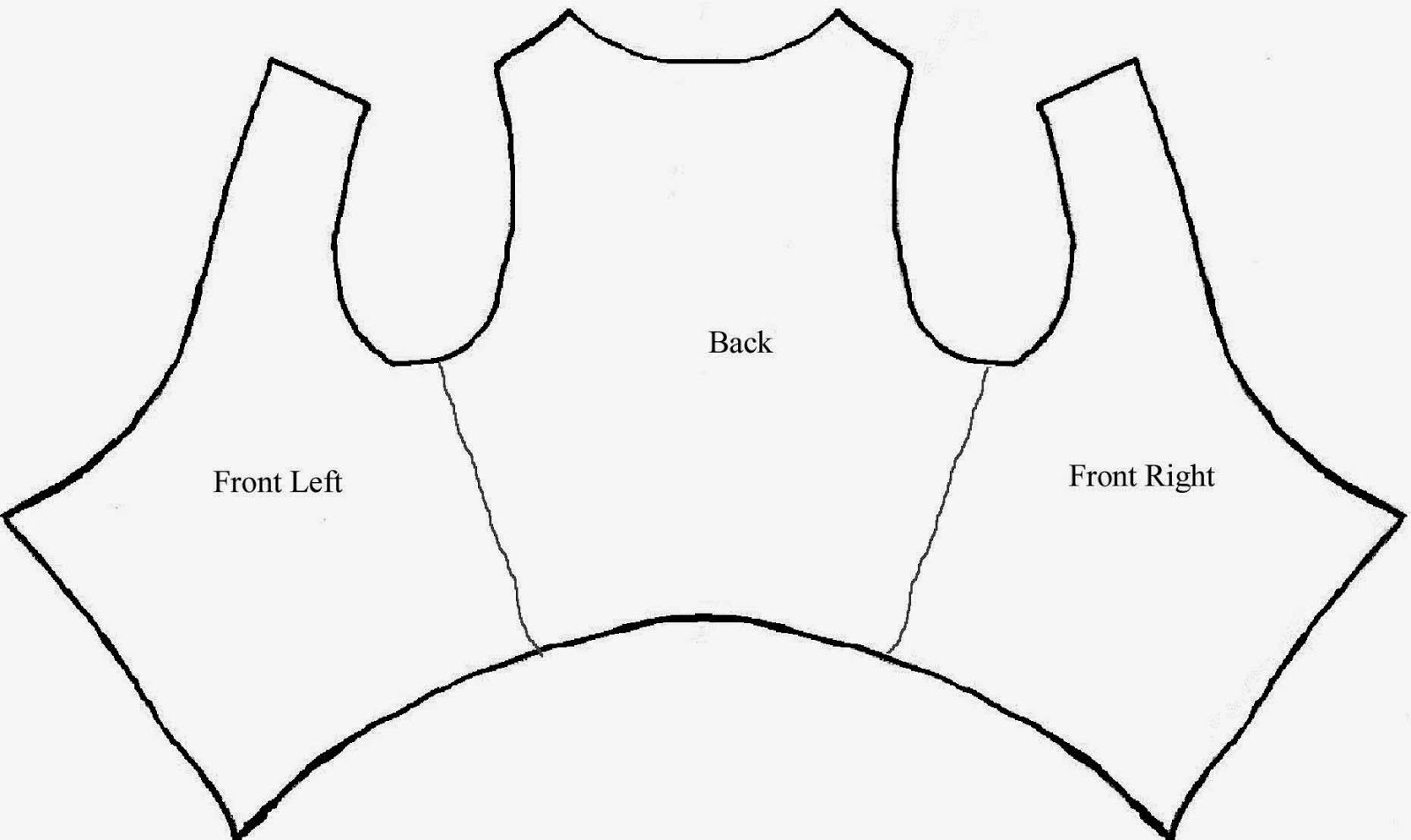
6. If the pattern is a simple vest with straight or slightly curved sides, I can use the back pattern piece to make a template for the seamless garment. To do this, I just use the enlarged back piece and add to the pattern at the neck, arm holes and the bottom.  I do this so I have no chance of accidentally running over the edge with some fiber and hooking together the front and back at these places.  The two overlapping fronts will be done one at a time to connect onto the back.   
Pat Spark enlarged vest pattern back

But usually, I want a more shaped garment so then I have another choice.  I make an enlarged template for each pattern piece. Then I lay out the fibers, textures, etc. using the templates as guides. I felt them down to size and sew them together.  (Or use the Embellisher - needle felting sewing machine - to attach them together.)  I usually extend the enlarged pattern pieces at the shoulder and the side seam so I can overlap the back piece and have an interesting felted edge.

Pat Spark enlarged vest pattern front


7. I haven’t tried the technique some people use which is to make each of the enlarged pieces of felt but keep the seam edges unfelted.  When the pieces are at pre-felt stage, you can overlap the unfelted seams and felt them together.  Then continue to felt the whole garment.  This looks as though it would allow a more shaped look but still be felted together instead of sewn. 

NOTE: In the following photos, the back pattern piece was extended at the side seams, to overlap the front pieces, while the front shoulders were extended to overlap the back piece.  Complicated I know, but I do this to help break up the vertical line caused by a sewn seam. Also, I LOVE irregular felted edges and don’t necessarily like straight, cut edges.

“Roses, Ruffles and Ripples, Oh My!” Felt vest by Pat Spark, © 2013.
(Textures influenced by Vilte Kazlauskaite.)

Pat Spark white felt vest
Vest from the Front


Pat Spark white felt vest from the back
Vest from the Back 

Pat Spark white felt vest from the side
Side Seam, Back Piece is Extended to Overlap the Front

Pat Spark white felt vest shoulder seam
Shoulder Seam, Front Piece is Extended to Overlap the Back
Pat Spark white felt vest
Detail of Front